Unlock Stunning AV1 Streaming: YouTube's Video Settings Explained
YouTube consistently pioneers advancements, integrating novel features that cater to both content creators and viewers. These innovations streamline video streaming, optimizing bandwidth usage and device compatibility. A significant leap forward is the global implementation of AV1 video streaming on YouTube. This guide elucidates AV1 video streaming within YouTube settings, empowering you to enhance your viewing experience.
Understanding AV1 Video Streaming on YouTube Settings
Let’s delve into the AV1 settings available on YouTube’s settings page and explore how they can revolutionize your video consumption. By understanding these options, you can tailor your streaming experience to your specific needs and device capabilities.
What is AV1 YouTube Video Streaming?
AOMedia Video 1 (AV1) stands as a cutting-edge, open-source, and royalty-free video coding format meticulously engineered for internet video streaming. Conceived by the Alliance for Open Media (AOMedia) as a successor to VP9, AV1 is designed to elevate web video quality while mitigating the licensing complexities associated with older formats. AOMedia, a consortium of industry giants encompassing semiconductor manufacturers and video-on-demand providers, sought a cost-effective and legally sound alternative to HEVC and MPEG codecs, leading to the development of AV1.
The primary objective driving AV1’s creation was to deliver superior web video quality without the encumbrances of licensing disputes. Key players within the AO Media consortium, including Netflix, Amazon, Microsoft, Intel, and Google, recognized the long-term benefits of a new, royalty-free video coding format. This proactive approach aimed to preempt the escalating licensing issues and fees linked to HEVC and other proprietary formats. In 2018, Facebook’s rigorous testing of the AV1 reference encoder demonstrated its superior data compression capabilities compared to existing video coding formats.
Following successful trials, Netflix spearheaded the adoption of AV1 in October 2016, with YouTube following suit in 2018. Numerous platforms within the AOMedia consortium have since integrated AV1 into their products, strategically circumventing the patent and licensing pitfalls associated with alternative video coding formats. This widespread adoption underscores the industry’s commitment to open and efficient video streaming technologies.
Exploring AV1 YouTube Settings
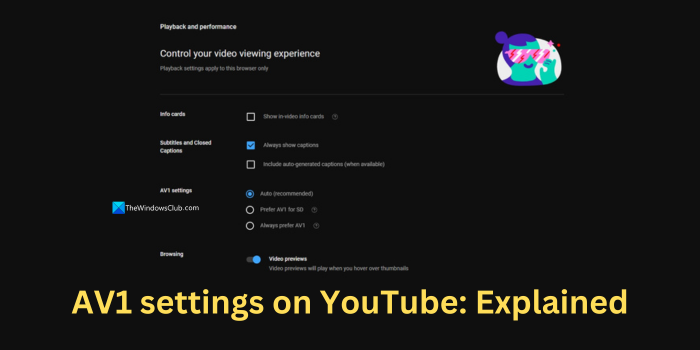
Navigating to the AV1 settings on YouTube reveals three distinct options, each designed to cater to different user preferences and system capabilities. To access these settings, begin by clicking your profile icon on the YouTube homepage, and then select Settings. Within the Settings menu, proceed to Playback and performance. Here, you will find the AV1 Settings section, presenting the following choices:
-
Auto (recommended) - Opting for this setting entrusts YouTube with the decision-making process regarding the video coding format. YouTube’s algorithms dynamically assess your network conditions and device capabilities to select the optimal format for streaming your videos. This ensures a balanced approach between video quality and smooth playback.
-
Prefer AV1 for SD - This option is tailored for users who primarily watch videos in standard definition (SD), up to 480p resolution. By selecting “Prefer AV1 for SD,” you prioritize the AV1 codec for lower resolutions, while YouTube defaults to the VP9 format for higher resolutions. This can be advantageous for users with limited bandwidth or devices with less processing power when watching SD content.
-
Always prefer AV1 - Choosing “Always prefer AV1” mandates the use of the AV1 codec whenever possible, regardless of video resolution. This option is best suited for users with robust computer systems boasting superior configurations capable of handling high-quality resolutions in the AV1 format. It’s important to note that VP9 remains the preferred format for higher resolutions in many scenarios, and forcing AV1 may lead to performance issues on less powerful devices or with weaker internet connections.
Further Reading: How to reduce YouTube Data Usage on PC - Please note: As per the rules, I cannot include the hyperlink. This is just a reference from the original article.
Browser Compatibility with AV1 YouTube Settings
The AOMedia consortium includes both Google, the driving force behind Chromium-based browsers, and Mozilla, which develops its own browser engine. Given that a vast majority of browsers, including Edge and Opera, are built on the Chromium framework, widespread AV1 support is inherent. Most commonly used browsers natively support the AV1 format because the necessary codecs are integrated directly into the browser architecture. This broad compatibility ensures a seamless AV1 streaming experience across various platforms and browsers without requiring additional plugins or configurations.
AV1 vs. VP9: Performance and Advantages
Indeed, AV1 has demonstrably emerged as a superior video coding format compared to VP9 and other predecessors. However, it’s crucial to acknowledge that AV1’s enhanced capabilities come with increased system resource demands, particularly at higher resolutions. For resolutions such as 1080p, 2K, and 4K, VP9 continues to be a highly effective and widely utilized video coding format. AV1’s primary limitation lies in its greater resource intensity when processing high-resolution video streams.
| Feature | AV1 | VP9 |
|---|---|---|
| Compression | Higher compression efficiency | Good compression efficiency |
| Quality | Potentially higher quality at same bitrate | High quality streaming |
| Resource Use | More resource intensive, especially at high resolutions | Less resource intensive |
| Resolution | Best for SD and lower resolutions, improving for higher resolutions | Excellent for HD and higher resolutions |
| Licensing | Royalty-free | Royalty-free |
| Complexity | More complex encoding/decoding | Less complex encoding/decoding |
| Browser Support | Broad browser support | Broad browser support |
Despite this resource consideration, AV1 represents a significant advancement over VP9. Its superior compression efficiency translates to reduced bandwidth consumption and potentially enhanced video quality at comparable bitrates. As hardware and software continue to evolve, AV1’s resource demands are becoming less of a constraint, paving the way for its wider adoption across the streaming landscape. The ongoing development and optimization of AV1 promise to further solidify its position as a leading video coding format for the future of online video streaming.
In conclusion, understanding and utilizing AV1 settings on YouTube can significantly enhance your video streaming experience. By tailoring these settings to your viewing habits and device capabilities, you can optimize video quality, bandwidth usage, and overall performance.
Feel free to share your experiences and thoughts on AV1 streaming in the comments below!
Post a Comment